Welcome to myblog.arts. This is your first post. Edit or delete it, then start blogging!
Introduction
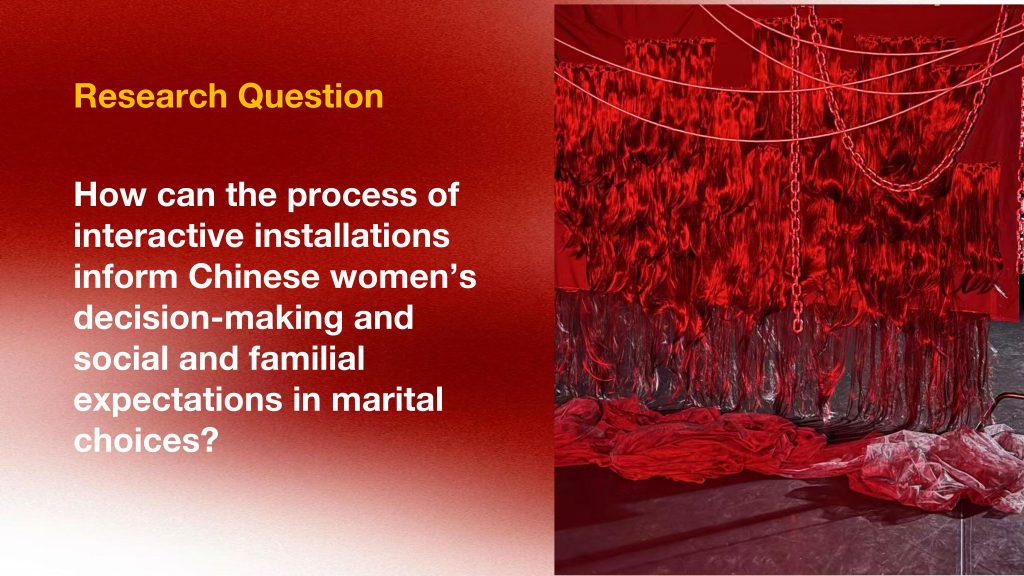
In Chinese society, marriage has long been regarded as a significant stage in a woman’s life, representing both social expectations and the continuation of familial hopes. The happiness of the previous generation was often rooted in specific economic and social conditions, whereas contemporary women face a different reality: while society calls for higher birth rates and promotes marriage and childbearing, families continue to expect women to find “fulfillment” through caregiving. However, an increasing number of young women aspire to independence and self-realization, yet are compelled to shoulder the dual responsibilities of both career and family.

This project employs interactive installation and video art to explore the familial and social expectations faced by Chinese women in their marital choices. Drawing inspiration from the historical and cultural figure of the self-combing woman (自梳女), the project uses this symbol as a mirror to reflect the contemporary condition of women, revealing how institutional norms shape individual choices through sensory and participatory artistic experiences. Using hair as a medium of consciousness, the work engages the audience through actions such as touching, braiding, cutting, and connecting—inviting them to physically sense the tension between marriage and social expectation.
In traditional Chinese culture, “the body, hair, and skin are received from one’s parents” (身体发肤,受之父母), and hair has been regarded as both an extension of the body and a symbol of filial piety (Ahern, 1978). For women, it further embodies identity and social roles. As a vital bodily symbol, hair carries gendered meanings within the institution of marriage—unmarried women wear their hair loose, while married women tie it up, distinguishing virtue and status through hairstyle (Zhang, 2020). Thus, hair is not merely part of the body but also a boundary between female identity and social norms. When self-combing women chose to comb their own hair, this act became a bodily gesture of symbolic resistance against the patriarchal structure of marriage.

The project constructs an experiential emotional narrative by juxtaposing the historical stories of self-combing womenwith the realities of contemporary women through spatial and cinematic storytelling. Through sensory and bodily interaction, participants are invited to physically experience the tension between marriage and autonomy, reflecting on the boundary between a “life expected by others” and a “life chosen by oneself.” The research further explores how interactive art, through processes of experience and empathy, can serve as a medium for rethinking the boundaries of gender, institution, and freedom.
References:
Ahern, E. (1978) ‘The power and pollution of Chinese women’, in Wolf, M. and Witke, R. (eds.) Women in Chinese Society. Stanford, CA: Stanford University Press, pp. 193–214.
Zhang, Y. (2020) ‘An analysis of the headdress of married women in China’s Tunpu community’, Art and Design Research, (Accessed 8 November 2025).