Author: Jin Tang

  • Installation × DanceScreen Collaboration at LCDS — FRAME SHIFT

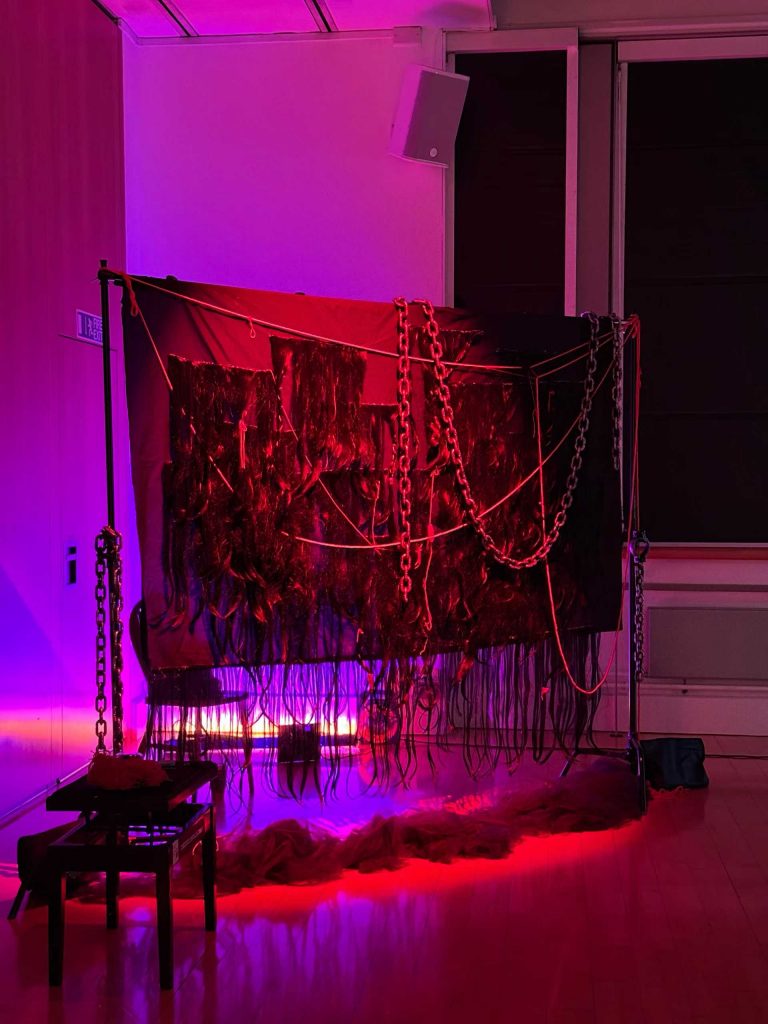
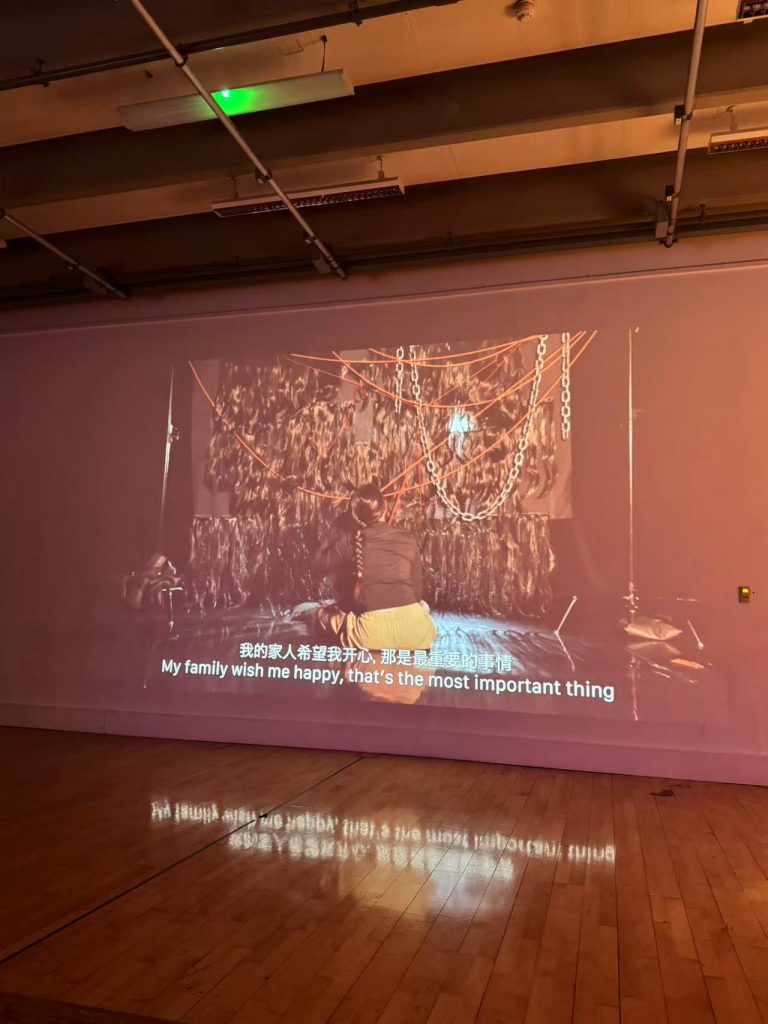
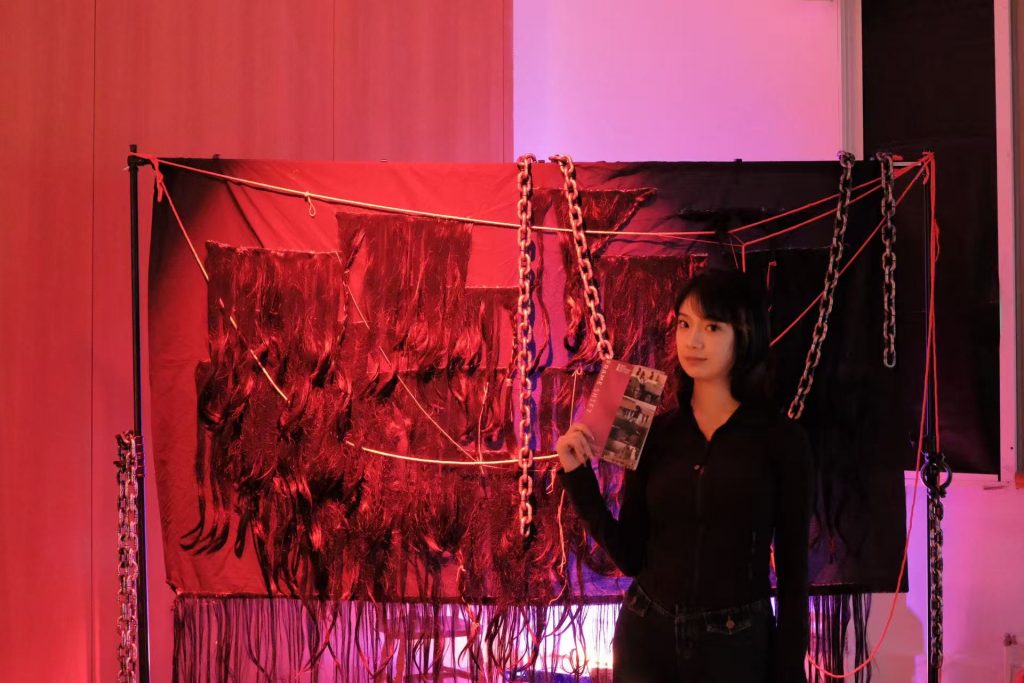
    This week, my installation and collaboratively created screendance film are exhibited at the FRAME SHIFT showcase at London Contemporary Dance School (The Place).

    The work consists of three interdependent components: installation + co-created film + embodied practice.

    Installation:

    Constructed using hair, red thread and fabric as primary materials, the installation builds a spatial environment that addresses marriage, the female body and socially conditioned expectations.

    Co-created film:

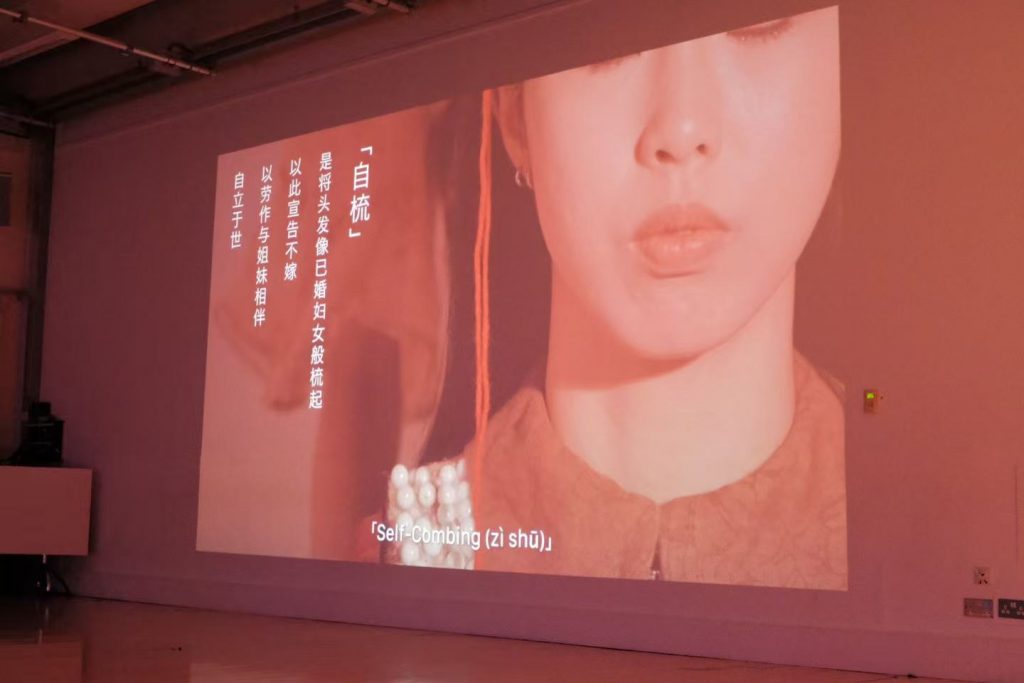
    Developed collaboratively with dancers and filmed within the installation, the work positions the interaction between movement and material as the central narrative mechanism, rather than as documentation of performance.

    Movement vocabulary:

    Derived from everyday postures, repetitive labour and ritualised gestures associated with the female body, this vocabulary informs both the film and the designed pathway of audience engagement within the exhibition space.

    Together, the three components operate relationally:

    the installation serves as a site for bodily experience;

    the film extends the temporal trace of bodily–material interaction;

    and the movement vocabulary provides a structural framework for navigating the relationship between installation and film.

    The most research-significant aspect of this exhibition emerged through the audience’s immediate responses—emotional, behavioural and embodied reactions that exceeded what is typically observed in installation-based exhibitions. One viewer experienced a notable emotional breakdown after engaging with both the film and the installation narrative.

    Unexpectedly, several older visitors (60+) did not interpret the work primarily as a critique of marriage. Instead, they described it as an invitation to reconsider intimacy, relational autonomy and personal worth.

    On-site feedback suggests that meaning is not contained within the work itself, but is continuously reconstructed through the audience’s interaction—emotionally, cognitively and physically—with the piece.
  • A critical interpretation of the installation through a qualitative and institutional lens

    In order to understand how this project might be perceived through a theoretical lens, I invited a qualitative researcher whose work is grounded in critical theory to write an interpretation of my installation.

    The following text is not about the visual or emotional effect of the installation, but reads the work as a critical apparatus that reveals institutional power through bodily experience.

    The installation does not treat “marital pressure” as a narrative theme, but as a structural experience. The work shifts the audience from viewer to participant, compelling the body to enter the system rather than reflect on it from outside. In this sense, the installation is not a medium of expression but a method of research: the viewer’s emotional discomfort, bodily hesitation, and impulse to withdraw function as live evidence of the marital institution.

    The softness of the materials never produces comfort; instead, it creates a gentle yet persistent pull. This “mild restraint” replicates the subtle disciplinary logic of reality: compliance is not achieved through violence but through intimacy, expectation, affection, and the narrative of “it is for your own good.” The installation does not simply present a “restricted female body”; it enables participants to experience “my body is being named, positioned, and evaluated by someone else.” The pain does not stem from being unable to leave, but from the fact that leaving would mean betraying the narrative that has already been imposed. This psychological mechanism is precisely what sustains the marital system.

    The core of the work is not sadness, but inescapable participation. The audience realizes that choice does not equate to freedom; departure is not neutral but carries consequences. Through this experience, the institution of marriage shifts from an abstract concept to a bodily predicament — its disciplinary force operates not at the level of logic, but at the level of muscles and nerves. In other words, the work does not merely represent structure — it makes structure happen inside the body.

    The installation does not ask viewers to “empathize with women,” nor does it attempt to “explain women’s struggles.” Instead, it poses a more unsettling question:
    When an institution is disguised as intimacy and happiness, do we still have the ability to recognize that we are being disciplined?
    This question cannot be answered through text, image, or representation — it can only be generated physiologically. The participant’s bodily struggle, emotional hesitation, and urge to escape are not by-products of the work; they are the research output itself.

    Therefore, the project is not a work about marriage, but a critical apparatus that forces the body to expose the logic of the marital institution. It transforms social power from invisible to tangible, from abstract concept to neural response, collapsing a macro-structure onto the level of skin and muscle. The participant’s disorientation and ambivalence are the very reasons the institution endures: power is not enforced through coercion, but through the gentle tone of “you should.”

    In this sense, the work is not expression but evidence.
    Not a reenactment of trauma, but an exposure of its mechanism.
    Not “she is trapped,” but “why am I being trapped right now?”

    This interpretation does not represent the only way to understand the work, but it reveals the methodological and theoretical potential of the installation form.

  • Different Reactions from Participants: One Installation, Many Emotional Trajectories

    Throughout the interactive sessions, I gradually realised that when the same lock of “hair” was placed in front of different women, their bodily reactions, emotional expressions, and behavioural choices diverged completely. These differences were not random—they were deeply intertwined with each participant’s family background, emotional memory, and personal understanding of marriage.

    Participants who described themselves as coming from happy families tended to slow down their movements when they approached the installation. They would first touch the hair gently, sensing its texture and weight, before hesitantly picking up the scissors—not to cut it off, but rather to trim it delicately, as if trying to make it “look better.” Some even commented, “I just want to make it neater,” or “It feels like I’m tidying up my life.”
    This act of trimming rather than destroying seemed to symbolise a desire to maintain relationships—to adjust and refine within the existing structure, rather than to break away from it.

    Those who said things like “my parents only want me to be happy” displayed another kind of interaction. They would rarely touch the scissors, choosing instead to pick up the comb and carefully run it through the strands, again and again. Some focused on untangling the knots; others said, “It feels like taking care of someone.”
    Their gestures carried no aggression or intent to change the hair’s form; instead, they expressed a gentle, continuous sense of care. In a way, this mirrored their emotional stance toward family and marriage—acknowledging the expectations that exist, yet still holding on to a space for tenderness and understanding.

    In striking contrast, those who spoke about feeling pressured by marital or social expectations reacted very differently. They would often make their decision almost instantly—reaching for the scissors without hesitation. Some tightened the hair before cutting it in one sharp motion; others did so with visible emotion, saying things like “I’m so tired of this” or “I just don’t want it.”
    Their actions were often fast, decisive, even slightly violent—not acts of decoration, but of cutting, rejecting, and ending. For them, the gesture of cutting symbolised much more than a physical act: it was a moment of release, a refusal of the scripted life paths imposed by family or society, a way to momentarily push back against the recurring sentence—“You should start thinking about marriage.”

    Through these contrasting reactions, it became clear that the installation offered no single “correct” way to engage. Instead, it functioned like a mirror, reflecting each participant’s personal history and internal dialogue.
    Some treated the hair as something to be cared for, others as something to be tended gently, and still others as something that must be severed to reclaim autonomy.
    These moments reminded me that the installation was not merely an artistic representation of marriage and womanhood—it was, through small embodied gestures like cutting, combing, and touching, a space where each woman could momentarily encounter her own story. Her relationship with family, her perception of parental expectations, and her negotiation with the institution of marriage were all made visible in that intimate, tactile encounter.

  • The Costume Design for the “Self-Combing Woman” in the Video

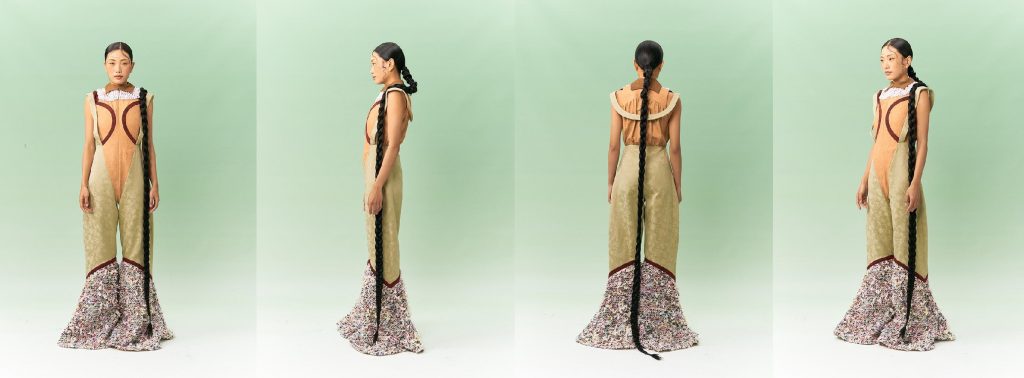
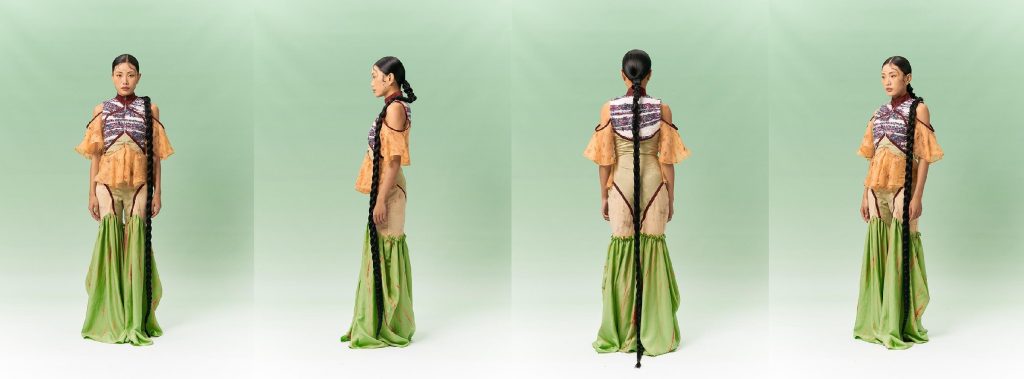
    The costume worn by the “self-combing woman” in the video originates from one of my earlier design works, which I reintroduced and reinterpreted within this project. The original piece was created during my previous research on the female body and social norms, where I explored how clothing could function as a medium to express the symbolic relationship between the body, structure, and gender order. Its integration into the current performance is not merely a visual extension, but a reactivation — allowing an earlier work to acquire new sociological and narrative meanings within this research context.

    The term “self-combing women” refers to a unique female group and cultural practice from the Pearl River Delta region in southern China. These women rejected feudal marriage systems and chose to remain unmarried for life. Many of them worked in the silk-reeling industry, weaving silk threads into fabric, and through labor and independence, constructed a self-defined way of living. Their existence embodies both resistance and courage, while also revealing the dual realities of institutional oppression and solitude.

    Drawing inspiration from this culture, the project incorporates the logic of silk-reeling craftsmanship into textile experimentation and structural design. The garment employs layers of woven silk threads, conveying both the softness and resilience of silk while symbolizing the invisible constraints imposed on women by social expectations. Its silhouette is inspired by an old custom in which women wrapped themselves in white cloth before marriage to signify chastity. By reinterpreting this ritualistic wrapping into a one-piece dress form, the design transforms symbolic constraint into a sculptural language that visualizes how the body is shaped — and confined — by social norms.

    Within the video, the costume takes on new narrative meaning. It no longer merely represents the image of a “self-combing woman,” but becomes a visual metaphor for the tension between body, history, and societal expectation. The movement of fabric and the performer’s gestures together construct a bodily language of female choice — one that constantly oscillates between softness and tension, freedom and restraint, resistance and submission.

    Ultimately, this design serves as both a tribute to the courage of the self-combing women and a dialogue across time — allowing the earlier work to speak again within a new context, connecting the historical struggles of women with contemporary reflections on marriage, autonomy, and freedom.

  • Exploring Emotional Narratives through Moving Image

    After completing the first round of audience intervention with the installation, I began to reflect on the independent role of the moving image in my research. I wondered: if viewers only watched the film without experiencing the installation physically, would they still develop a similar sense of empathy or emotional engagement?
    With this question in mind, I invited several new participants—who had not taken part in the previous installation session—to engage with the project solely through the narrative film.

    Their feedback turned out to be surprisingly insightful. Even without the physical presence of the installation, the film was able to evoke emotional resonance and stimulate reflection. One participant mentioned that the repeated act of “combing” in the performance felt both gentle and suffocating, like a ritual shaped by social expectations. Another said that the dancer’s gestures and rhythm reminded her of her own tension between familial and societal roles. In different ways, the moving image allowed them to confront the unspoken emotions and contradictions embedded in women’s lived experiences.

    Compared to those who interacted with the installation, these viewers tended to interpret the work through the lens of “story” and “performance” rather than through material or bodily engagement. They focused on composition, pacing, and emotional transitions—observing how movement and narrative conveyed meaning. This contrast highlighted two distinct modes of understanding: while the installation relies on spatial and tactile immediacy, the film communicates through emotional continuity and visual narrative.

    This comparison led me to reconsider the distinct yet complementary functions of installation and film within the research.
    The installation invites a bodily, situated experience—viewers interpret tension through movement, touch, and spatial awareness.
    The film, on the other hand, constructs an emotional and symbolic layer, guiding viewers through rhythm and narrative progression. Together, they form a dual structure of storytelling that is both embodied and emotional, physical and symbolic.

    From a methodological perspective, this cross-media combination enriches the research by expanding its expressive and communicative dimensions. The moving image not only extends the narrative of the installation but also stands as an independent research medium—capable of disseminating ideas and sparking reflection beyond spatial constraints.

    Based on both sets of feedback, I have come to realise that the most effective order of intervention should be “watching the film first, followed by the interactive experience.”
    The film provides an emotional and cultural foundation, allowing participants to enter the installation with a clearer sense of context and empathy. This sequential process—from emotional preparation to embodied engagement—creates a deeper and more reflective audience experience, demonstrating how narrative and participation can together shape an understanding of social issues through art.

  • Ethics and Consent Statement

    All participants involved in the Her Hair, Her Choice project have read and signed the official Participant Consent Form. These signed consent forms are securely stored by the researcher and will not be shared publicly.
    Regarding the interviews involved in the documentary, consent forms have been collected and securely held by my collaborator, who is responsible for the filming and storage of related materials. Therefore, I am unable to share those copies directly. During the signing process, all participants were informed that they have the right to withdraw their interviews or appearances from the documentary at any time without consequence. For this reason, the documentary will not be publicly displayed.
    The documentary footage is under the director’s usage rights and will only be used for project presentation purposes. The separate art video, which does not include any interview content, is part of the publicly accessible work and can be exhibited freely.

  • Video Feedback Reflection: Body, Emotion, and Understanding

    Introduction

    As the narrative video became an essential part of my interactive installation, I wanted to explore how it influenced audience engagement and interpretation. To do so, I invited several participants who had experienced both the video and the installation to take part in a small feedback session.

    Method

    Four participants from different cultural backgrounds were invited for short one-on-one conversations after viewing the installation and the video.
    Each discussion focused on three main questions:

    1. What emotions did the video evoke for you?
    2. Did it help you understand the symbolism of hair and the self-combing women?
    3. Did the bodily performance relate to your own sense of social expectation or freedom?

    Their responses were documented and later analysed thematically.

    Key Findings

    Most participants described the video as intuitive and emotionally charged. They felt that the dancer’s movement embodied a kind of “silent resistance,” conveying tension and struggle more directly than words.
    Interestingly, when the Asian female performer appeared on screen, almost everyone reacted with visible surprise and excitement—some gasped softly, some said “she’s so powerful,” and others mentioned, “seeing her move felt like seeing myself.”
    Several viewers also expressed strong appreciation for the Black female dancer, describing her movements as “raw and powerful,” presenting a very different kind of energy.
    Many participants commented on the visual quality and costume design, saying that “the imagery is beautiful,” “the clothes are stunning,” and “the lighting made the emotions stronger.”
    These responses suggest that the audience connected not only with the conceptual themes but also with the aesthetic and sensory dimensions of the work—the video evoked resonance on both emotional and visual levels.

    Reflection

    Through this feedback process, I realised that the video is not merely a narrative supplement to the installation, but an independent sensory and affective medium. It transforms the audience from observers into emotional participants, extending the research from tactile interaction to visual and emotional resonance.
    In future iterations, I plan to integrate audience feedback more deeply into the choreography and visual composition, allowing the dialogue between body and viewer to continue evolving.

  • Embodied Empathy: When Cultural Symbols Travel Across Borders

    Although the primary stakeholders of this research are Chinese women, the interventions conducted in the UK have attracted participants from diverse cultural backgrounds. Their feedback revealed that the installation not only reflects the conditions of Chinese women within the institution of marriage, but also resonates with the shared pressures faced by women across societies.

    During the exhibition, I invited participants from China, Singapore, Korea, the UK, and Canada to step into the installation. Without prior explanation, they encountered the red threads and hair through touch, movement, and stillness — each forming a silent conversation between their cultural memories and embodied emotions.

    Audience Feedback:

    These responses revealed how emotion transcends cultural background. Participants from East Asian contexts perceived the red thread as a symbol of confinement and destiny, while Western participants resonated with the softness and vulnerability of the hair. This demonstrates how bodily experience and material symbolism can serve as a universal emotional language.

    Initially, I thought the work belonged solely to the Chinese context — a reflection of women bound by familial and social expectations. Yet when a British viewer described feeling “ritual and solemnity,” I realised that marriage, gender, and the body are shared concerns across societies. Each woman meets her own “red thread” — as fate, duty, or tenderness.

    Academically, this feedback supports my assumption of embodied empathy: people can connect emotionally through sensory engagement, even without shared language or cultural background. Here, art functions as a form of cultural translation, transforming physical materials into emotional bridges.

    Ultimately, I realised that art is not only a way to expose structural oppression but also a means to cultivate understanding. When women from different worlds stand before the same red thread, touch it, pause, and feel — they are, in that moment, connected through empathy.

  • Filming the Unspoken: Women Reflecting on Marriage, Body, and Freedom

    In this collaborative project, my friend and I co-created two video works — an art film and a documentary.
    The documentary unfolds through five guiding questions, exploring how women from different cultural and generational backgrounds understand marriage, gender roles, and freedom.

    These five questions correspond to five symbolic stages in the life journey of the self-combing women (zishunü, women in early 20th-century China who vowed to remain unmarried and independent):

    1. Have you ever been pressured by your family or society to get married? What was that like?
    2. What does marriage mean to you, personally?
    3. Were you ever expected to embody a certain idea of femininity — in how you should walk, sit, or stand, or in the roles you were expected to take on as a woman?
    4. When was the first time you felt like your body didn’t fully belong to you?
    5. How do you define freedom or agency in your life?

    Each question is linked to a corresponding scene and ritual of the self-combing women:

    • The Combing Ritual: an older self-combing woman combs the hair of a younger woman who is about to take the vow — symbolizing her choice to remain unmarried and independent for life.
    • The Wedding Ceremony: in history, self-combing women held a symbolic “wedding” ritual to declare their lifelong celibacy; before this, they would wrap themselves in white cloth to signify purity.
    • The Chains Scene: the self-combing woman interacts physically with iron chains. The chains symbolize both the constraints of social institutions and gender norms, and the internal struggles and resistance of the self.
    • The Black Veil in a British Church: a contemporary self-combing woman wears a black veil inside a foreign church, symbolizing an identity that transcends time, culture, and geography — and the solitude it entails.
    • Cutting the Red Thread: representing the final moment of liberation — breaking free from societal expectations and reclaiming autonomy.

    In the documentary, these five questions are answered by participants from diverse cultural, generational, and personal backgrounds — some from Eastern societies, others living in the West; some single, some married, others choosing solitude.
    We invited each participant to respond freely to one of the questions on camera while interacting with the installation:
    some touched the red thread, some grasped the chains, some wore the black veil —
    these embodied gestures bring abstract reflection back into sensory experience, allowing personal memories and the symbolic meanings of the installation to resonate with each other.

    This structure of “response – interaction – reflection” turns the film from mere documentation into a live process of thinking.
    Through tactile engagement, each participant re-experiences the boundaries and weight of being “female.”

    Through this collaborative video project, we aimed to create a shared space where women across cultures, generations, and identities could speak, remember, and redefine the meaning of autonomy.
    Every answer, every silence, and every gesture became part of a collective tapestry of memory.
    These moving images are not only about marriage or gender —
    they are about how women, within layers of constraint, continue to seek control over self, body, and destiny.

    This is not only a filmic collaboration,
    but also a dialogue among women —
    in front of the camera, we look back together, and together, we begin to rewrite.

  • From a Single Role to a Double Burden: Why Are Modern Women Reluctant to Enter Marriage?

    With economic development, rising levels of female education, and increased employment opportunities, contemporary society has begun encouraging women to enter the workforce rather than remain solely in caregiving roles. However, China is currently in a period of value transition: women are encouraged to pursue careers, yet the cultural expectations surrounding gendered division of labour have not evolved accordingly.

    For the older generation, marriage represented a pathway to “withdrawing from the labour market in exchange for security”—women provided domestic and childcare labour in return for men’s financial support and social protection (Yan, 2003). In contrast, the situation for today’s women is fundamentally different. They are expected not only to build a professional identity in the workplace, but also to take on the primary share of domestic responsibilities at home, including housework, elder care, childcare, and emotional labour.

    American sociologist Arlie Hochschild, in her seminal work The Second Shift, introduced the concept of the “second shift” to describe the widespread phenomenon in which women, after completing a full day of paid work, return home to perform unpaid domestic labour (Hochschild and Machung, 1989). This concept is highly applicable to the experiences of contemporary Chinese women: after work, they continue with a “second shift” of household duties, while men’s participation in childcare and housework remains limited.

    Research further shows that despite women’s increased educational attainment and economic independence, the unequal gendered division of labour within the institution of marriage has not fundamentally changed. Leta Hong Fincher (2014) notes that Chinese women often take on a disproportionately large share of housework and caregiving responsibilities after marriage, meaning that marriage no longer functions as a “safe haven” for women but, instead, becomes a structure that intensifies their burdens. As a result, women’s expectations and willingness to enter marriage have significantly declined.

    Consequently, more women today recognise that marriage no longer offers the clear benefits and security it once did for previous generations. Rather, it often entails constrained career development, reduced personal time, and increased emotional and caregiving labour. It is not that women reject intimate relationships; they are rejecting a system that adds responsibility without offering reciprocal support.

    References

    Fincher, L.H. (2014) Leftover Women: The Resurgence of Gender Inequality in China. London: Zed Books.

    Hochschild, A.R. and Machung, A. (1989) The Second Shift. New York: Viking.

    Yan, Y. (2003) Private Life under Socialism: Love, Intimacy, and Family Change in a Chinese Village, 1949–1999. Stanford, CA: Stanford University Press.