Author: Jin Tang

  • How do family expectations influence Chinese women’s marriage decisions?

    When discussing the pressure to get married, people often attribute it to societal norms, cultural traditions, or policy-driven expectations. However, throughout my field research, another source emerged repeatedly—one that is more intimate, emotionally charged, and deeply rooted: the expectations that come from within the family.

    Across a series of in-depth interviews, I found that the strongest pressure to marry often comes from female elders—mothers and grandmothers—rather than from fathers or male relatives. This finding was both unexpected and thought-provoking: Why do women from the previous generation become the primary agents of marital pressure?

    To understand this phenomenon, I conducted a focused interview to explore why female family members so often act as the key drivers of urging marriage.

    One interviewee shared that the greatest pressure she felt to get married did not come from her father, but from her mother and grandmother. Her mother firmly believed that “marriage is something every woman must go through.”When the interviewee expressed that she was not ready for marriage, her mother replied:

    “Once you get married, life becomes stable. A woman only feels secure when she has her own family.”

    The interviewee emphasised that her mother was not intentionally forcing her into marriage; rather, this belief stemmed from her mother’s own lived experience—that marriage had brought her happiness and security. She said:

    “My mum is part of the generation whose life genuinely improved after marriage. She and my dad became financially stable, their relationship was harmonious, and life got better. So she truly believes marriage is a good thing for women.”

    For her mother’s generation, marriage indeed served as a form of upward social mobility. Many women gained access to resources, social status, and a sense of security through marriage. In this context, marriage was not a limitation, but a means of “escaping hardship” and “achieving a better life.”

    As the interviewee concluded:

    “She wants me to take the same path because it is the only route to happiness she has ever known.”


    Why Did the Previous Generation Believe Marriage Was the Path to Happiness?

    To understand the marriage values held by women of previous generations, we must return to the socio-historical environment in which their beliefs were formed. Through conversations with women from my participants’ parents’ generation, it became clear that “marriage brings happiness” was not an imagined ideal, but a lived reality rooted in the social structure, economic conditions, and gender norms of the time.

    In the 1980s–1990s, traditional gendered division of labour remained dominant in Chinese households: men were expected to be the primary breadwinners, while women carried out domestic and caregiving roles (Yan, 2003). Within this structure, women’s social value and personal security were largely tied to marriage and family roles, rather than to independent career development. Marriage was not merely a romantic relationship—it functioned as a form of practical life security.

    Furthermore, the post–reform economic boom significantly improved living standards. Many women experienced tangible life improvements after marriage—better housing, increased family income, enhanced social welfare, and greater financial stability (Zhang, 2010). For them, marriage truly resulted in visible, measurable gains. Under these conditions, viewing marriage as a reliable route to stability and happiness was both reasonable and beneficial.

    As a result, women of that generation genuinely believed—on the basis of their own lived experiences—that marriage equalled stability, happiness, and “having someone to rely on.” Yet this sense of happiness was shaped by historical and structural conditions, not by marriage itself.

    However, it is important to recognise that this model of “marital happiness” was built on a highly gendered family structure: women exchanged domestic labour and caregiving for men’s financial provision (Fong, 2004). This exchange shaped their worldview and informed how they advised their daughters.

    In other words, their insistence that “marriage is good for women” did not arise from control or conservatism, but rather because—in their time—marriage was the most reliable and socially sanctioned pathway for a woman to secure a good life.


    References

    Fong, V. (2004) Only Hope: Coming of Age under China’s One-Child Policy. Stanford, CA: Stanford University Press.

    Yan, Y. (2003) Private Life under Socialism: Love, Intimacy, and Family Change in a Chinese Village, 1949–1999. Stanford, CA: Stanford University Press.

    Zhang, L. (2010) In Search of Paradise: Middle-Class Living in a Chinese Metropolis. Ithaca, NY: Cornell University Press.

  • When We Talk About “Hair”: A Deep Conversation on Race, Beauty and the Body

    Recently, I had a conversation with a Black woman about “hair” — yet we quickly realised that what we were discussing was never just hair, but the intersection of body, identity, race, beauty standards, and intergenerational trauma.

    The interviewee mentioned that within many Black communities, “straight hair is still seen as beautiful” — a perception not rooted in Black culture itself, but heavily shaped by colonial, Eurocentric beauty ideals. Historically and today, racialised aesthetics have labelled Black women’s natural Afro-textured hair as “messy,” “unprofessional,” or “hard to manage”, pushing many women to straighten or suppress their natural curls in order to fit into white-dominated workplace and social standards.

    Although the “natural hair movement” in recent years has encouraged more Black women to embrace Afros, braids, locs, and protective styles, the interviewee noted that the desire for smoothness and sleekness still lingers within the community, reflecting the ongoing influence of these internalised beauty norms.

    During our conversation, she further shared that in some contexts, wider hips among Black women are considered “not attractive” or “not feminine enough.” This belief may sound absurd, yet it is deeply rooted in history — specifically, the internalisation of a white, slender, delicate ideal of femininity.

    Colonial discourses have long demonised and objectified Black women’s bodies — sexualising them on the one hand, while de-feminising them on the other, attaching labels such as “strong,” “masculine,” or “too big.” In the white gaze, wider hips and a stronger physique have been perceived as deviating from femininity, a perception that has gradually become internalised as self-surveillance and self-doubt within Black communities.

    Ahmed (2004) argues that the body becomes “oriented” toward certain social ideals through cultural conditioning, continually adjusting itself to meet norms and expectations. Within this system of discipline, hair and the body become two key arenas where women learn to “correct” themselves.

    This conversation made me realise that although the embodied experiences of Black and East Asian women stem from distinct historical trajectories, both are shaped by powerful mechanisms of social regulation.

    In Chinese culture, Confucian ethics — such as the belief that “our body, hair, and skin are given by our parents and must not be harmed” — constructed a moral framework around women’s appearance, requiring them to present a body that is “orderly, modest, and obedient” to signal filial piety and virtue. Later, Japanese, Korean, and Western beauty standards layered onto this foundation, producing a modern ideal of the “fair, youthful, slim, and delicate” woman. Chinese women, too, are socialised to manage their posture, control their body shape, and style their hair according to socially accepted aesthetics.

    The paths of regulation differ:

    • Black women: assimilation pressures rooted in colonial histories and white aesthetic dominance
    • Chinese women: Confucian bodily ethics reinforced by contemporary media-driven beauty standards

    Yet the outcome is strikingly similar — women learn to view their own bodies as something that must be corrected.

    Hair and the body are not simply matters of “personal choice”; they are projections of power structures. When women begin to embrace their natural hair textures and recognise their inherent bodily features, it is more than an aesthetic shift — it is a political act, a form of decolonisation, and a reclaiming of narrative power.

    Reference:

    Banks, I. (2000) Hair Matters: Beauty, Power, and Black Women’s Consciousness. New York: New York University Press.

    Ahmed, S. (2004) The Cultural Politics of Emotion. Edinburgh: Edinburgh University Press.

    DeLongoria, M. (2018) ‘Misogynoir: Black Hair, Identity Politics, and Multiple Black Realities’, Africology: The Journal of Pan African Studies, 12(8), pp. 39–49.

  • From Hair to Identity: A Century of Chinese Women’s Hairstyles

    Hair has never been just hair.
    In Chinese cultural tradition, it is considered part of the body — a symbol of morality and social order. The ancient saying goes, “The body, hair, and skin are given by our parents; we must not harm them — this is where filial piety begins.” This belief established a fundamental idea: the body belongs to the family, not to the individual. Hair, therefore, was never merely a matter of appearance; it carried the meanings of lineage, continuity, and identity. For women, this view of the body implied a gentle but profound constraint — their hair was expected to be neat, obedient, and unaltered.
    It was not until the early twentieth century that this order began to crack. The May Fourth Movement in 1919 became a turning point for intellectual awakening. Female students took scissors to their long hair — an act that symbolized both a break from feudal morality and the birth of a “new woman.” Cutting their hair was not simply a matter of style, but a political gesture: they used their bodies to express independence and resistance.
    Meanwhile, in the Pearl River Delta of southern China, another group of women chose a quieter but equally radical path. They combed their own hair in a self-initiated ritual — the self-combing ceremony — to declare lifelong celibacy. These self-combing women rejected marriage as an institution and took their hair as an oath, using daily ritual to reclaim sovereignty over their bodies.
    In the 1930s, the image of women in cities changed again. The fashion of permed hair swept from Shanghai across the country; “iron tongs” and “water curls” became the new symbols of modernity. Western styling and cosmetics entered daily life, and women began to converse with modern society through their appearance. Hairstyles were no longer merely signs of obedience or rebellion — they became a form of self-expression. Women were no longer just objects to be seen; they began to perform themselves.
    This sense of freedom, however, was soon interrupted by war. In the 1940s, when “the Chinese nation was in its most perilous time,” countless women cut off their long hair — for survival, for military service, or for escape. Short hair in this period symbolized action and resolve; it represented a body forced to bear responsibility in times of crisis.
    After the founding of the People’s Republic in the 1950s, society entered a new phase of idealism. Double braids became the standard hairstyle for unmarried women — neat, simple, and healthy. It reflected the values of equality and labor, forming a new collective aesthetic. In the 1960s and 1970s, this style became even more uniform: short hair and short braids dominated. Gender differences were blurred, and women’s bodies were almost completely absorbed into the collective narrative.
    With the reforms of the 1980s, individuality began to reawaken. Permed hair, voluminous curls, and even afros appeared on the streets. Women once again used their hair to shape themselves — it was an expression of freedom and optimism, a belief that the future belonged to them. In the 1990s, television and cinema became the new classrooms of beauty. Faye Wong’s short hair, Gong Li’s soft waves, and Brigitte Lin’s long straight hair shaped an entire generation’s imagination of “beauty” and “self.” Hairstyles extended beyond fashion — they became expressions of identity and attitude.
    In the twenty-first century, the internet changed everything. Hairstyles were no longer defined by celebrities but created and circulated by ordinary young women online. Dyeing, layering, and self-styling became new visual languages of individuality. The body was now constantly redesigned within digital space. Hair became both a medium of self-expression and a marker of identity in an age of fluidity.
    From “The body, hair, and skin are given by our parents” to “self-combing,” and finally to “styling as one pleases,” hair has recorded the social and bodily history of Chinese women across a century. It has passed through obedience, rebellion, imitation, and reinvention — bearing witness to how women, in an ever-changing society, have used the softest of things to define themselves.
    Sometimes I think hair matters precisely because it exists on the boundary between the body and the world. It belongs to us, yet grows beyond us. It can be cut, shaped, and controlled — but it never stops growing.
    Perhaps that is why hair remains one of the most enduring symbols of female experience.

  • When Symbols Travel: Red Threads, Hair, and Cross-Cultural Empathy

    Although my research initially focused on the relationship between Chinese women and the institution of marriage, and my stakeholders were Chinese, the intervention conducted in the UK attracted women from different cultural backgrounds to participate. Their feedback made me realize that this device not only reflects the situation of Chinese women in the marriage system, but also reveals the common pressures that women face in different societies.
    The two core materials used in the installation – red thread and hair – originally symbolized marriage, restraint and physical connection in the context of Chinese culture. Red symbolizes marriage in China, and hair is also a very important element in the history of Chinese women. However, with the participation of women from the UK, South Korea, Singapore, Canada and other places, these symbols have been constantly “retranslated”.
    For the participants from China and Singapore, the red thread and hair brought a sense of oppression and unease, symbolizing the fate of women entangled by social expectations.
    Korean participants interpreted the red thread as a metaphor for fate – whether they like it or not, individuals are always connected by some invisible thread.
    Women from Canada and the UK, although not familiar with these cultural symbols, felt an emotional resonance the moment they touched their hair. They talked about that soft, genuine and almost intimate touch, which reminded people of the universality of the “body” as a shared experience.
    These cross-cultural perspectives broaden the significance of the research: the fact that audiences from different cultures can establish emotional connections with material symbols through sensory experiences indicates that my approach is effective in emotional communication. The same symbol (red line, hair) is reinterpreted in different cultural contexts, which makes me think about the flow and redefinition of cultural symbols in a global context.
    Ultimately, I realized that art, through the combination of physical experience and symbolic materials, can not only present the oppression of social structures but also serve as a cross-cultural medium to promote understanding and empathy.

  • Reflective Journal — Enhancing Narrative and Storytelling

    In my latest installation test, I found that the interactivity of the work met expectations – the audience was full of curiosity about the materials and was willing to step forward to touch, try and participate. However, I also realized that most of the time, I needed to be beside them to introduce the inspiration source and background story of the installation. This reaction came more from my oral explanations rather than the emotions conveyed by the work itself. However, merely interacting with the installation itself makes it difficult for the audience to immerse themselves in the story and emotions. The installation itself lacks a strong emotional appeal and is hard to achieve narrative quality.
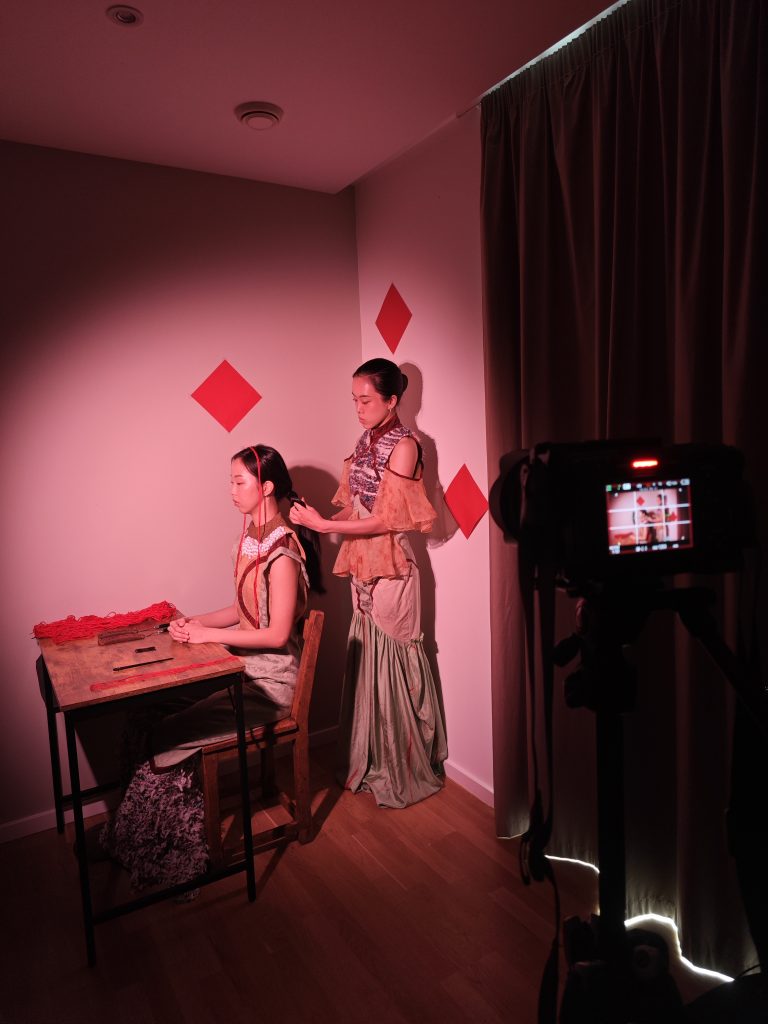
    To enable the audience to delve deeper into the context of the work, I decided to incorporate video narrative, using images to reinforce the history and emotions behind the “self-combing woman”. I collaborated with a friend who studies dance, attempting to recreate the spiritual ritual of the “self-combing girl” through body language and performance.
    The story of the video will include five scenes:
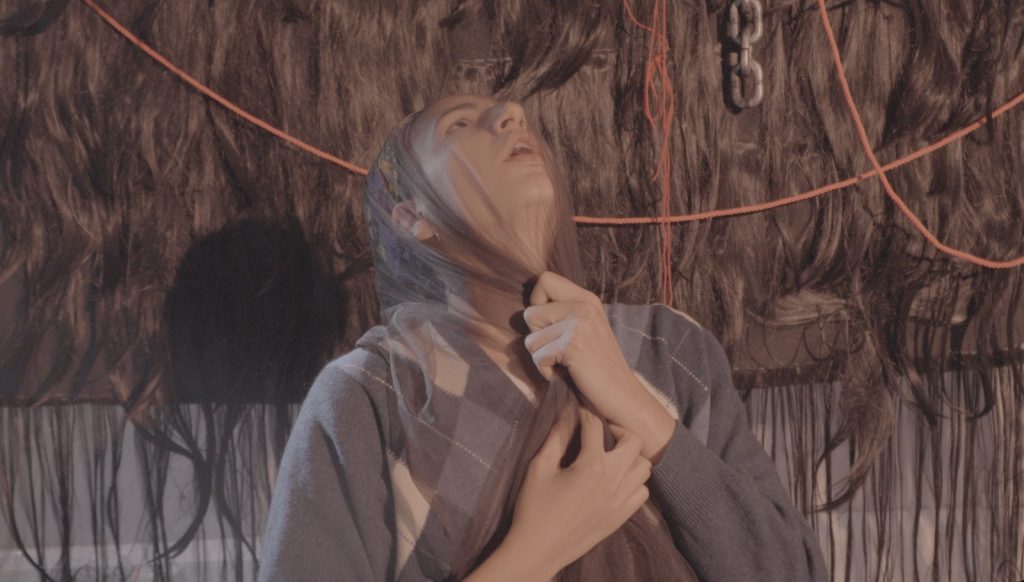
    Combing ceremony – A woman who has become a self-combing woman combs the hair of another woman who is about to become a self-combing woman, symbolizing her choice to remain independent and unmarried for life.
    Wedding ceremony – In ancient times, self-combed women would have a symbolic “wedding” to have a cemetery after death. Before getting married, they would wrap themselves in white cloth to maintain their chastity.
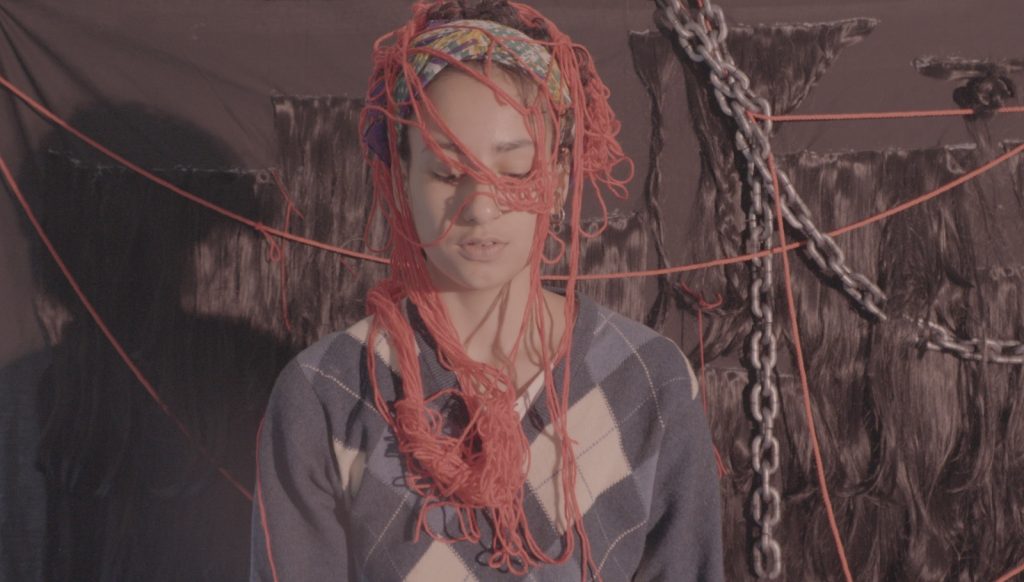
    The iron chain scene – The self-combing woman has a physical interaction with the iron chain. The iron chain not only symbolizes the constraints of social systems and gender norms, but also represents her struggle and struggle in consciousness.
    The black veil in a British church – a self-combed woman in the contemporary era wears a black veil in a foreign church, symbolizing an identity and loneliness that transcends time and space.
    Cutting the red line – symbolizing the moment when she finally breaks away from social expectations.
    I hope to enhance the narrative and immersion of the work through the combination of video and installation, allowing the audience not only to “use” the installation but also to enter the story through their senses and emotions.

  • When Art Opens a Hidden Door

    During one of my interventions, there was a moment that left a deep impression on me. After experiencing my installation, one participant had a very strong emotional reaction. In the interview that followed, she began to talk about the abuse she had suffered in her childhood. She told me that it was the first time she had ever spoken about this secret she had buried deep inside for many years. At that moment, I realized that this installation was not merely an artwork—it had become a medium of emotional activation and release, offering participants a space to confront, express, and reinterpret their own experiences.

    This encounter left me with a profound sense of both awe and responsibility. On one hand, I was deeply moved by her honesty and courage—her willingness to reveal her most vulnerable memories in a completely unfamiliar setting. On the other hand, I began to rethink my own role as both an artist and a researcher. My installation was initially intended to explore women’s emotional and structural dilemmas within social systems, yet when it inadvertently touched someone’s trauma, its meaning transcended research or artistic expression—it became a vessel of real human emotion.

    I started to reflect: while evoking empathy and emotional resonance, had I created a space that was truly safe for participants? How can art balance between healing and re-triggering pain? This moment redefined my understanding of “intervention.” It is not merely a social exploration or a form of creative experimentation—it is, at its core, a genuine encounter between people on a psychological and emotional level. In that fragile yet honest instant, I witnessed the true power of art as a form of social engagement.

  • From the “Self-Combing Women” to the “Unmarried Generation”: Why Do Chinese Women Still Face the Same Pressure a Century Apart?

    Introduction

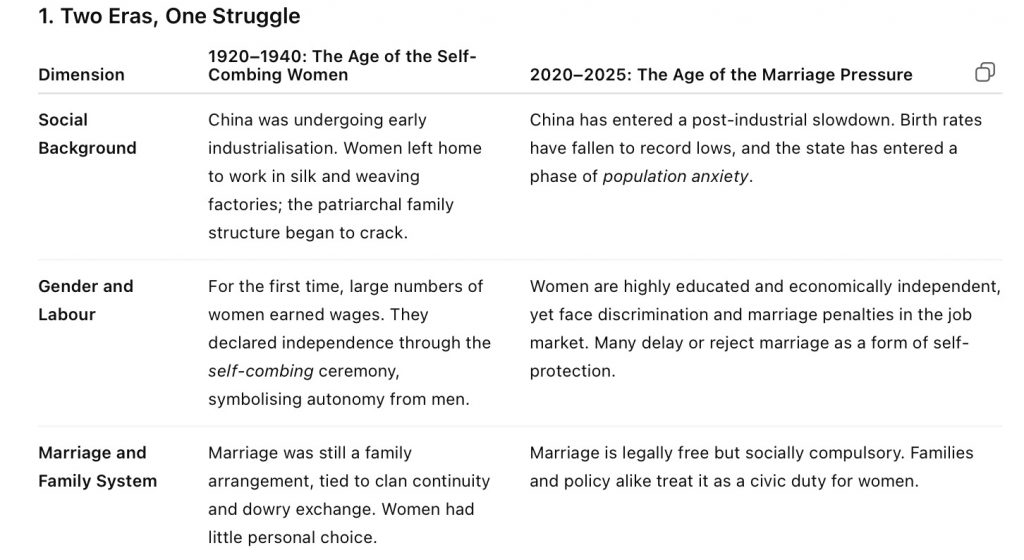
    When I began studying the self-combing women (自梳女) of southern China, active between the 1920s and 1940s, I was struck by an eerie sense of repetition.
    These women—textile workers in Guangdong and Hong Kong—refused to marry, choosing to earn their own living and declare lifelong celibacy through a ritual act of “self-combing.”
    Almost a century later, in 2025, Chinese women once again find themselves under intense social and policy pressure to marry and give birth.

    Why do different generations of women, separated by time and social systems, face the same question of whether to marry at all?
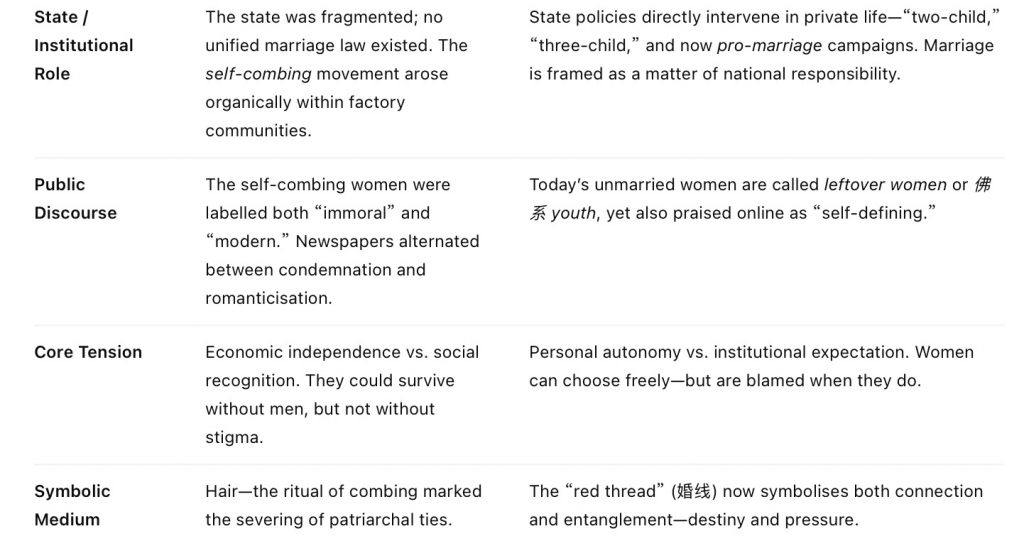
    To answer this, we need to trace the structural logic behind both eras—how economy, family, policy, and ideology shape the meaning of “womanhood” in different historical moments.

    2. The Repeating Structure of Control

    Across both eras, the same triangular power structure reappears:

    State → Family → Female Body

    Whenever women’s labour or bodies move outside this structure, society reacts with anxiety.

    • In the 1920s, it was the fear of women leaving the family economy.

    • In the 2020s, it is the fear of women leaving the reproductive economy.

    The form of pressure has changed—from open patriarchal control to “soft persuasion” through policy and media—but the underlying logic remains:

    The freedom of women becomes visible only when it threatens existing systems.

    1. The Repeating Structure of Control
      Across both eras, the same triangular power structure reappears:
      State → Family → Female Body
      Whenever women’s labour or bodies move outside this structure, society reacts with anxiety.
      In the 1920s, it was the fear of women leaving the family economy.
      In the 2020s, it is the fear of women leaving the reproductive economy.
      The form of pressure has changed—from open patriarchal control to “soft persuasion” through policy and media—but the underlying logic remains:
      The freedom of women becomes visible only when it threatens existing systems.
    2. Resistance as Continuum
      Both groups of women, though separated by a century, chose resistance through life design rather than protest.
      The self-combing women ritualised independence through their hair, creating female communes that redefined kinship.
      Contemporary women ritualise independence through their lifestyle—education, career, and the right not to marry or give birth.
      In both cases, resistance is domestic, embodied, and deeply personal.
      It transforms private choices into social statements.

    The line connecting these points is cyclical:
    when women gain autonomy, the system tightens control.

  • Reframing the Ritual: The Story and Fabric of Self-Combing Women

    To make the background of my installation and intervention more powerful, my partner and I decided to incorporate the background story of “self-combing women” into the video work. This decision stems from our hope to enable the audience to have a more intuitive understanding of the female experience and spiritual symbol of “refusing marriage” in the historical context of China.
    The main part of the image focuses on the hair-combing ceremony of the self-combing women – when they reach adulthood, they hold a ceremony symbolizing “independence” for themselves, thereby announcing that they are no longer bound by the institution of marriage. During the shooting process, we attempted to present the repetition and calmness of this ritualized movement with a slow camera pace and close-up shots, allowing the audience to sense the determination and loneliness contained in their “self-combing” action.
    Meanwhile, the costume design part in the video was also independently created by me.Women who choose to remain unmarried for life due to their resistance to feudal etiquette and the pursuit of autonomy are called “self-combing women”. Most of them make a living by reeling silk, weaving it into flexible and tough silk, just like their lives.
    Inspired by self-combing women, I incorporated the silk reeling technique into my fabric weaving experiments, exploring cultural and emotional expressions through the medium of “silk”. The design of the clothing pattern also originated from old customs – traditional women often wrapped themselves in white cloth before marriage to show their chastity. I transformed this ritualized “wrapping” into the design language of an integrated one-piece structure, symbolizing that the body is bound by social norms, while also demonstrating the individual’s will to seek self-definition in suppression.

  • What the Red Thread Means to Them

    During the exhibition, I observed how audiences from different cultural backgrounds interpreted the red threads in strikingly diverse ways. Korean participants told me that, within East Asian culture, the red thread symbolizes destiny and emotional connection—it carried deep meaning for them. Participants from other countries, however, simply saw it as thread. Chinese and Singaporean viewers found it eerie, even unsettling, while several Canadian visitors described it as both powerful and fragile. One whispered, “It looks like real hair—so soft, I feel like I should protect it.”

    These reactions made me realize that the materiality of the work speaks in multiple cultural languages. What one group perceives as sacred connection, another experiences as discomfort or fear. This diversity of interpretation expanded the meaning of the work far beyond my initial intention—it became not only a reflection on Chinese womanhood, but also a cross-cultural dialogue about how intimacy, the body, and destiny are perceived and embodied across different societies.