To make the background of my installation and intervention more powerful, my partner and I decided to incorporate the background story of “self-combing women” into the video work. This decision stems from our hope to enable the audience to have a more intuitive understanding of the female experience and spiritual symbol of “refusing marriage” in the historical context of China.
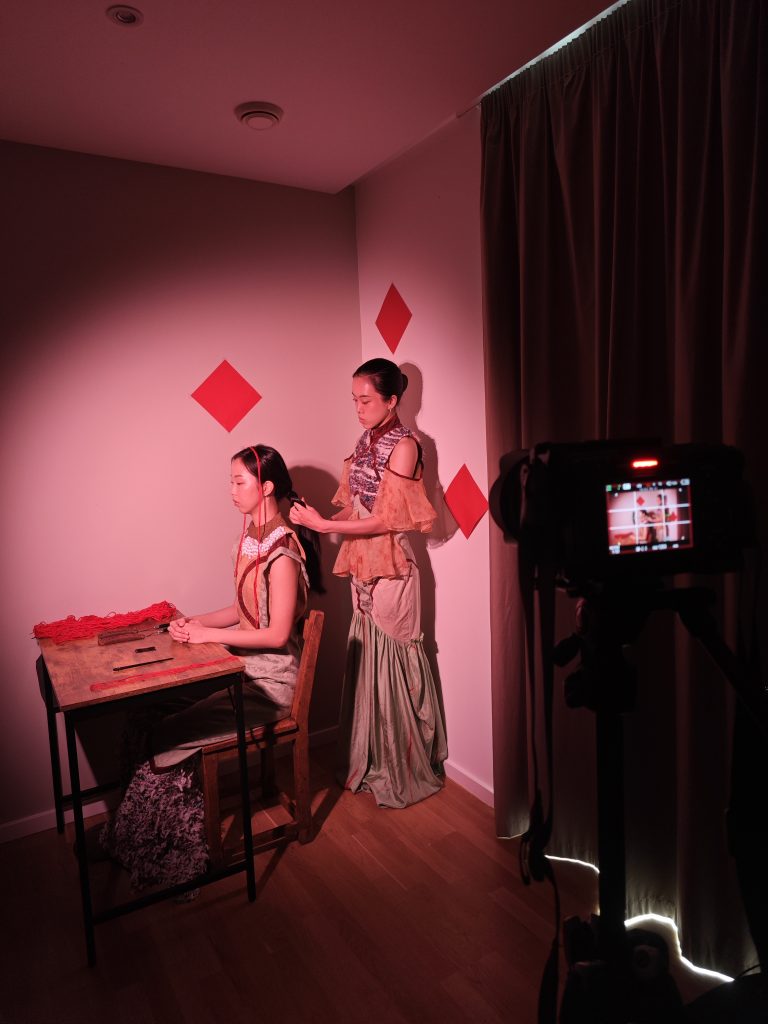
The main part of the image focuses on the hair-combing ceremony of the self-combing women – when they reach adulthood, they hold a ceremony symbolizing “independence” for themselves, thereby announcing that they are no longer bound by the institution of marriage. During the shooting process, we attempted to present the repetition and calmness of this ritualized movement with a slow camera pace and close-up shots, allowing the audience to sense the determination and loneliness contained in their “self-combing” action.
Meanwhile, the costume design part in the video was also independently created by me.Women who choose to remain unmarried for life due to their resistance to feudal etiquette and the pursuit of autonomy are called “self-combing women”. Most of them make a living by reeling silk, weaving it into flexible and tough silk, just like their lives.
Inspired by self-combing women, I incorporated the silk reeling technique into my fabric weaving experiments, exploring cultural and emotional expressions through the medium of “silk”. The design of the clothing pattern also originated from old customs – traditional women often wrapped themselves in white cloth before marriage to show their chastity. I transformed this ritualized “wrapping” into the design language of an integrated one-piece structure, symbolizing that the body is bound by social norms, while also demonstrating the individual’s will to seek self-definition in suppression.
Leave a Reply