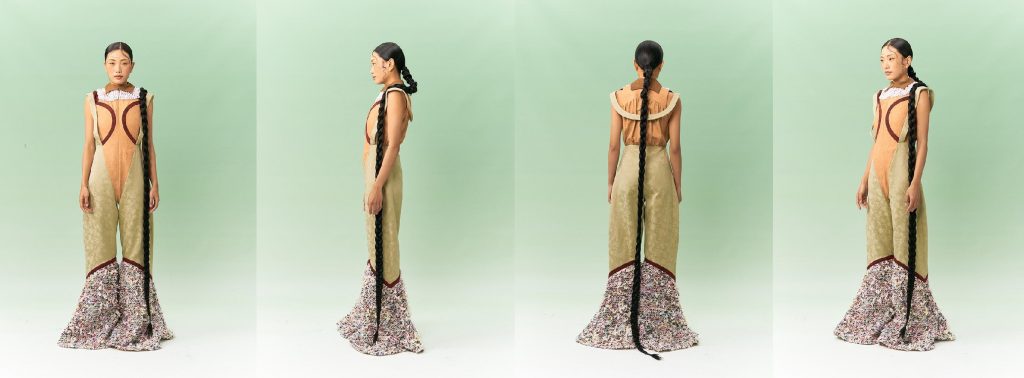
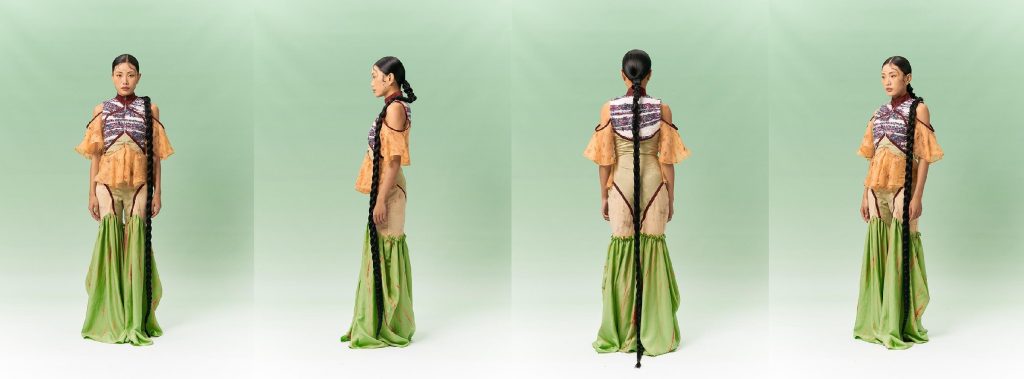
The costume worn by the “self-combing woman” in the video originates from one of my earlier design works, which I reintroduced and reinterpreted within this project. The original piece was created during my previous research on the female body and social norms, where I explored how clothing could function as a medium to express the symbolic relationship between the body, structure, and gender order. Its integration into the current performance is not merely a visual extension, but a reactivation — allowing an earlier work to acquire new sociological and narrative meanings within this research context.
The term “self-combing women” refers to a unique female group and cultural practice from the Pearl River Delta region in southern China. These women rejected feudal marriage systems and chose to remain unmarried for life. Many of them worked in the silk-reeling industry, weaving silk threads into fabric, and through labor and independence, constructed a self-defined way of living. Their existence embodies both resistance and courage, while also revealing the dual realities of institutional oppression and solitude.
Drawing inspiration from this culture, the project incorporates the logic of silk-reeling craftsmanship into textile experimentation and structural design. The garment employs layers of woven silk threads, conveying both the softness and resilience of silk while symbolizing the invisible constraints imposed on women by social expectations. Its silhouette is inspired by an old custom in which women wrapped themselves in white cloth before marriage to signify chastity. By reinterpreting this ritualistic wrapping into a one-piece dress form, the design transforms symbolic constraint into a sculptural language that visualizes how the body is shaped — and confined — by social norms.
Within the video, the costume takes on new narrative meaning. It no longer merely represents the image of a “self-combing woman,” but becomes a visual metaphor for the tension between body, history, and societal expectation. The movement of fabric and the performer’s gestures together construct a bodily language of female choice — one that constantly oscillates between softness and tension, freedom and restraint, resistance and submission.
Ultimately, this design serves as both a tribute to the courage of the self-combing women and a dialogue across time — allowing the earlier work to speak again within a new context, connecting the historical struggles of women with contemporary reflections on marriage, autonomy, and freedom.
Leave a Reply